Like the majority of the industry in 2009, I thought Uncharted 2 was a revolutionary game that finally merged the techniques known from cinema with what we know about how games work and how players interact with them into something absolutely captivating, immersive and spectacular. The first fully successful translation of action-adventure movies into game format and one of the first admirable implementations of film language into interactive video game sections overall. In terms of camera work, level design and animations, Uncharted 2 broke new grounds that very few developers have been able to reach ever since.
Ten years later, like a decent chunk of developers and critics, I still think Uncharted 2 is one of the best games to be ever made, with undisputable qualities and the ability to check all the marks for all sorts of different types of people with varied preferences. And like a somewhat smaller group of gamers, I have very similar feelings towards the two Uncharted sequels. The ability to repeat the same feats, rekindle the same feelings and create something of mostly on-par quality is enough to earn a place in my heart, not to mention the little experimentations and inventions built on top of the U2 foundation.
But because of smaller novelty, slightly less stellar pacing and lack of a game-changer on par with the U2 train sequence, even I have to admit that I would put these titles slightly lower on my top games lists. And yet after all was said and done, Naughty Dog made one more game, a spin-off with Nathan Drake nowhere in sight, instead focusing on Uncharted 2’s Chloe Frazer and Uncharted 4’s Nadine Ross. Uncharted: Lost Legacy was a title I enjoyed so much that unlike its predecessors, it’s on my Games Of The Decade list.
Friday, 3 January 2020
Thursday, 2 January 2020
[GO10s] #10: Rhythm Heaven Megamix
Aaand we’re opening the list with a remaster/repackaging. Decade’s looking great so far!
Jokes aside, my only previous experience with the series was the DS “Rhythm Heaven”, and I haven’t played the Japan-only GBA “Rhythm Tengoku”, nor Wii’s “Rhythm Heaven Fever”, so this entry allowed me to catch up on all the great games I’ve missed. Moreover, Megamix has also added as many new minigames as it borrowed from every previous iteration, not to mention the new “Remixes” (songs where player jumps from minigame to minigame), so I think it has enough new content to merit its placement on lists like these.
Wednesday, 1 January 2020
[GO10s] Intro and Honorable Mentions
It occurs to me that I’ve never actually written a GOTY list. Sure, I’ve posted my “favorite top5” or something along those lines, but I never wrote a long, thought-through article explaining why 10 particular titles from a given year touched me in a way that others haven’t. On one hand, I enjoy this kind of writing and video games have been my primary hobby for the majority of my life. On the other, in the past few years I’ve often joked about “hating video games” or that “all video games are bad”, which were hyperboles, but with a hint of truth within them - especially in that last decade, I’ve definitely struggled with finding titles I’d enjoy.
Without getting too deep into how my gaming habits changed over time, nowadays I’m someone who gets really bothered by cumbersome UI, has no patience for boring pacing and finds bad controls inexcusable. And with endless backlog and tons of interesting titles available for cheap or free at any given moment, the value of “I already bought this game so I’m getting my money’s worth” is already way below the value of my time. Add the fact that I’ve always been hooked to one or more “game as a service” at a time, and that I’ve never really played many of the games that end up on mainstream GOTY lists, and you can probably see why I didn’t feel like my voice in this space was really all that necessary.
Monday, 11 November 2019
There will be no revolution
In September of 2011 I was at the official afterparty for the International Festival of Comics and Games in Łódź. It was the part of event during which all the official speeches were held and awards were handed out. And at the end, a musical act would play. That year the audience got a real treat - a joint performance by two esteemed artists. The first one was a well known local act called Cool Kids of Death, a somewhat controversial alternative rock outfit. The second was a famous Japanese video game music composer Akira Yamaoka, best known for the Silent Hill soundtrack. People who came to the show were probably expecting that the famous international guest would take the center stage and the local band would be the backup.
That didn't happen. The first half of the show was just CKOD playing their original songs. Public was lukewarm and mostly waiting for Akira to take the stage. That happened about half-way through the show - but public was suprised to learn that for this part, the ensemble is gonna keep playing local band's songs, just with addition of Yamaoka on guitar. The band already has two guitarists so quite frankly, an additional one didn't make much of a difference in the sound. Public groaned. Finally, the vocalist announced that it's time for songs from Silent Hill. And they played them, but for just 10 minutes - after 3 tracks, the show was over.
It was the first time I saw CKOD and I became a fan right away. I immediately connected with the sound and lyrics, the attitudes and the underlying message. They were my favorite band for a very long time and will probably always remain somewhere in my top 10. But as far as I know, a lot of people had the opposite reaction - they came there to see Akira and they hated the fact that he was a very small part of the show, and hated Cool Kids for "hogging the spotlight". The band gained one loyal fan, but put off the wide audience. Years later, I realize that this was the most CKOD outcome possible.
That didn't happen. The first half of the show was just CKOD playing their original songs. Public was lukewarm and mostly waiting for Akira to take the stage. That happened about half-way through the show - but public was suprised to learn that for this part, the ensemble is gonna keep playing local band's songs, just with addition of Yamaoka on guitar. The band already has two guitarists so quite frankly, an additional one didn't make much of a difference in the sound. Public groaned. Finally, the vocalist announced that it's time for songs from Silent Hill. And they played them, but for just 10 minutes - after 3 tracks, the show was over.
It was the first time I saw CKOD and I became a fan right away. I immediately connected with the sound and lyrics, the attitudes and the underlying message. They were my favorite band for a very long time and will probably always remain somewhere in my top 10. But as far as I know, a lot of people had the opposite reaction - they came there to see Akira and they hated the fact that he was a very small part of the show, and hated Cool Kids for "hogging the spotlight". The band gained one loyal fan, but put off the wide audience. Years later, I realize that this was the most CKOD outcome possible.
Sunday, 3 November 2019
The many themes of Gatchaman Crowds
I love Gatchaman Crowds. I’ve been thinking about it a lot ever since having watched both seasons late last year, because there’s a lot to think about. It does so, so much cool stuff on all fronts - themes, iconography, storytelling, audiovisual artistry, I just can’t help but gush all over any and all of its facets pretty much all the time. From clever directing tricks to unusual topics touched upon, the show is truly exceptional and worth everyone’s attention.
So, what is it about? Well, it’s a difficult question to give a straightforward answer to, and it almost begs the cliched answer of “what is it NOT about?” Truthfully, I do think that you could make a convincing argument or at least five different things to be the one “it’s really about”. GC is so dense with plot points and theming that it’s hard to discuss it with an orthodox breakdown.
This is your usual spoiler warning. I won’t give a play-by-play of what happens in a given episode and I try to not give away too much in general, but I spoil the stuff I wouldn’t mind if someone spoiled me on, and I think I’m a bit more tolerant than average in that regard.
So, what is it about? Well, it’s a difficult question to give a straightforward answer to, and it almost begs the cliched answer of “what is it NOT about?” Truthfully, I do think that you could make a convincing argument or at least five different things to be the one “it’s really about”. GC is so dense with plot points and theming that it’s hard to discuss it with an orthodox breakdown.
This is your usual spoiler warning. I won’t give a play-by-play of what happens in a given episode and I try to not give away too much in general, but I spoil the stuff I wouldn’t mind if someone spoiled me on, and I think I’m a bit more tolerant than average in that regard.
Wednesday, 7 August 2019
Panchi Line
My small obsession with Kotaro Uchikoshi continues as I delve into one of his latest works - Punch Line, an anime he worked on as the writer. I was interested in seeing how a story made by him in a completely different genre than Zero Escape would look, and what I didn’t expect was just how many conventions would return, even though some of them felt completely tied to his most famous VN series’ premise. With that said, let me start by describing what this show’s about. I’m gonna spoil the kind of stuff that I wouldn’t mind if someone else spoiled me on, but I’m probably above average in terms of spoiler tolerance, so this is your fair warning.
Tuesday, 18 June 2019
Granbloobloo versus
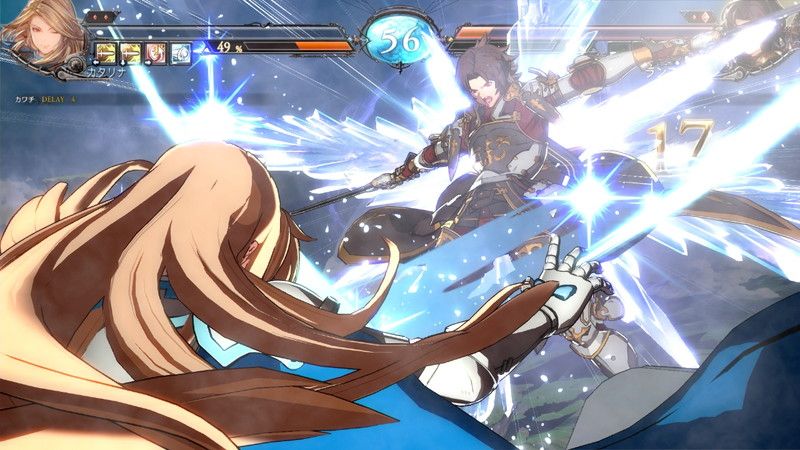
To say I came into the Granblue Fantasy Versus beta with a lot of scepticism would be an understatement. I dislike majority of ArcSys games and this one seemed to lean closer to the end of their spectrum that is least appealing to me, with Guilty Gear-style graphics and tempo. At the same time it promised to be significantly less complex and less demanding of knowledge and controller proficiency than their staple franchise, but that doesn’t really make the pitch any better. Moreover, a lot of the messaging from producers was further discouraging - talk of making the game simpler so that it can be “less about combos and more about strategic” and “more accessible” and constantly prattling about esports set off all my red flags. And the nail the in the coffin - the cooldown system restricting the use of specials in a variety of ways is something that fighting games have experimented with before (Rising Thunder, League of Fighters), but in general it just doesn’t seem like a good idea. So with that entire premise, how’s GBFV?
It’s ok.
It’s ok.
Subscribe to:
Posts (Atom)